Table of Contents
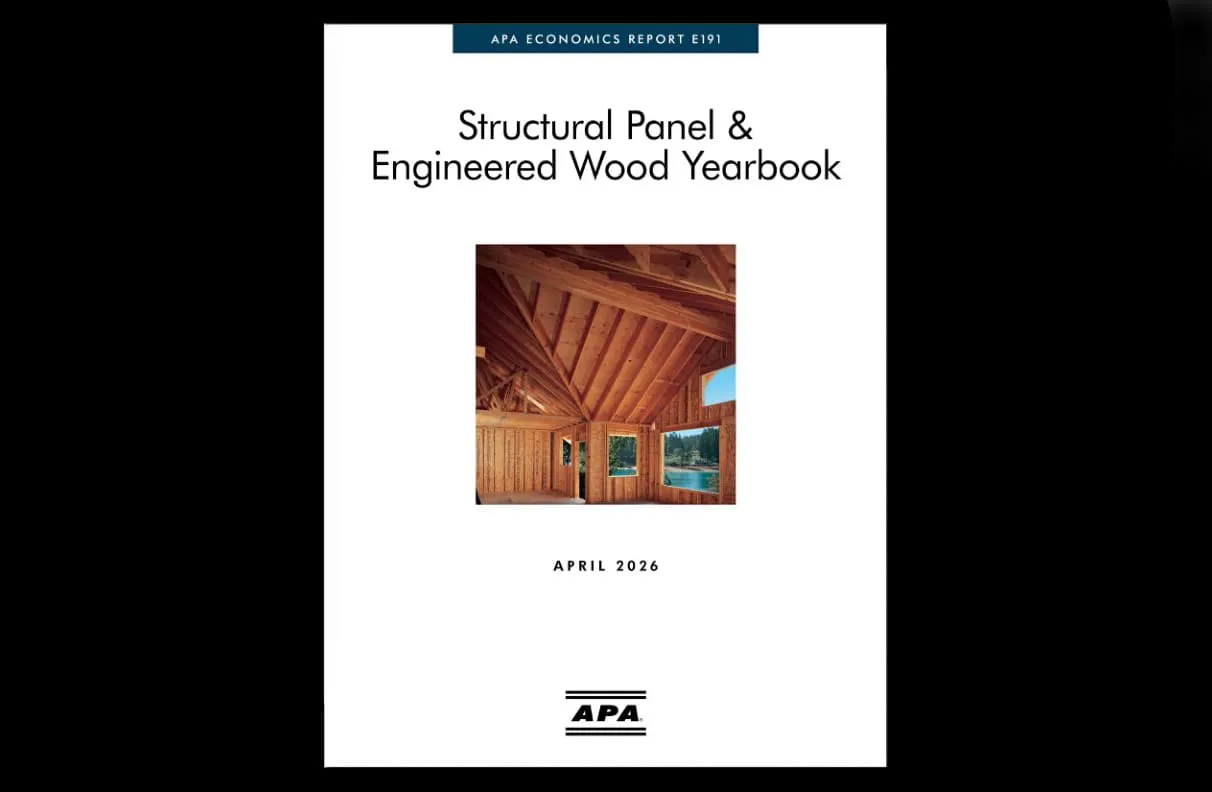
Elevated tariff rates, a frozen housing market and the sharpest slowdown in U.S. net immigration in decades are converging to constrain demand for engineered wood products in 2026. What those forces mean for the engineered wood industry is examined in depth in the 2026 Structural Panel & Engineered Wood Yearbook, prepared by APA’s vice president of economic analysis and market research Jennifer Coskren. The yearbook analyzes the key economic and market factors driving demand for engineered wood products in North America.
Updated information in the 2026 Yearbook includes:
• Historical and current production statistics for structural panels (oriented strand board and plywood).
• North American product import and export levels.
• U.S. and Canadian nonresidential and industrial construction statistics.
• Demand and production for glulam, I-joists and LVL.
The U.S. economy achieved 2.1% real GDP growth in 2025 and carried that momentum into the first quarter of 2026, despite significant volatility driven by tariff front-loading, a government shutdown, and rising energy costs tied to the ongoing conflict in the Middle East. The Federal Reserve's ability to bring down long-term rates has been more constrained in this cycle than in prior ones, complicating monetary policy in ways that historical comparisons do not fully capture.
These headwinds have weighed heavily on housing. Mortgage rates averaged 6.8% in 2025, and while showing some improvement in early 2026, rates resumed their climb on renewed energy and inflation concerns. Homebuying sentiment sits at historically low levels, and while the prime-aged homebuyer population remains large, it is beginning to roll over from its demographic peak. Affordability constraints and elevated rates continue to suppress buying activity, and vacancy rates—while gradually improving—remain lean by historical standards.
Against that backdrop, single-family construction is forecast to decline again in 2026, averaging 910,000 units for the year. It is not surprising, then, that engineered wood markets, which are largely driven by residential construction, face a difficult environment. Structural panel production is forecast to fall to 31.6 billion square feet in 2026. Meanwhile, I-joist and LVL production are each expected to grow just 1.0%, while glulam and cross-laminated timber should see a modest lift from continued growth in nonresidential applications.
The entire 2026 market forecast, including all market segments and production outlook, as well as statistical data, is included in APA's 2026 Structural Panel & Engineered Wood Yearbook, Form E191. The yearbook can be purchased for $1,290 at shop.apawood.org.
Founded in 1933 and based in Tacoma, Wa., APA represents about 175 plywood, oriented strand board, glulam timber, wood I-joist, rim board, cross-laminated timber and structural composite lumber mills throughout North America. Its primary functions are quality auditing and testing, applied research and market support and development. For more information, visit www.apawood.org.